


/Course Certificates/Hazards Communication 29 CFR 1910.1200 Certificate - American Institute of Safety Professionals.webp)
/Course Wallet Front/Courses Student Wallet Card Front - American Institute of Safety Professionals USA.webp)
/Course Wallet Back/Courses Student Wallet Card Back - American Institute of Safety Professionals USA.webp)

265 Hackensack St
Wood Ridge, New Jersey 07075 USA
SAFETY IS NOT A CHOICE, IT'S A RESPONSIBILITY WE OWE TO OURSELVES AND THOSE AROUND US
Hazards Communication 29 CFR 1910.1200
- January 01, 2026 - December 31, 2026
- Flexible Timings
- Open Enrollments
- Online Zoom Sessions or LMS
- +1 689 286 3561
- info@amiosp.com
Course Overview
The Hazard Communication 29 CFR 1910.1200 course from the American Institute of Safety Professionals provides comprehensive training on OSHA 29 CFR 1910.1200, the standard that establishes the worker’s right to know about the hazardous chemicals in their workplace. Hazard Communication (HazCom) is consistently among the top five most frequently cited OSHA standards across all industries because it applies to virtually every workplace that uses or stores hazardous chemicals — which is virtually every workplace. From the cleaning products in an office to the process chemicals in a refinery, if hazardous chemicals are present, HazCom applies. The standard was updated in 2012 to align with the Globally Harmonized System of Classification and Labelling of Chemicals (GHS), creating a standardised international framework for chemical hazard communication.
The HazCom standard requires four integrated components: a written hazard communication programme, a chemical inventory listing every hazardous chemical in the workplace, Safety Data Sheets (SDS) for every hazardous chemical (accessible to all employees during every shift), and employee training on chemical hazards and protective measures. The 2012 GHS alignment standardised the format for both labels and SDS: GHS labels use pictograms, signal words (Danger or Warning), hazard statements, and precautionary statements in a standardised format, while SDS follow a mandatory 16-section format that ensures consistency across every chemical from every manufacturer worldwide.
The curriculum covers the HazCom standard requirements (§1910.1200), the written hazard communication programme (required elements, multi-employer worksite provisions), chemical inventory development and maintenance, the 16-section SDS format (section-by-section guidance on reading and interpreting SDS), GHS label elements (product identifier, pictograms, signal words, hazard statements, precautionary statements, supplier identification), the nine GHS pictograms and the hazards each represents, hazard classification system (physical hazards, health hazards, environmental hazards, hazard categories and severity), workplace container labelling (shipped containers versus workplace containers, secondary labelling alternatives), employee training requirements (§1910.1200(h)), non-routine tasks and unlabelled pipes, trade secret provisions, and the programme management that sustains HazCom compliance over time.
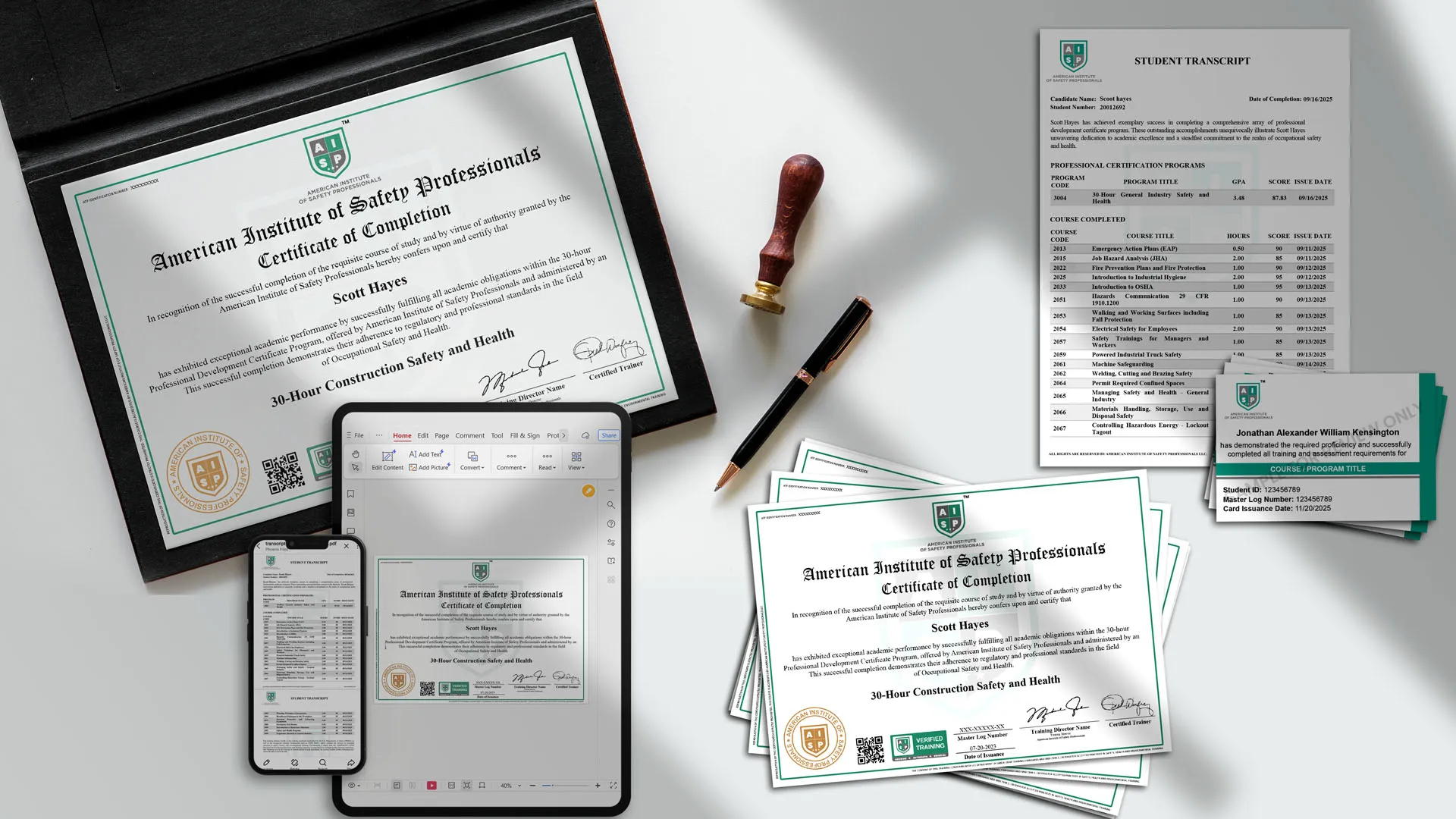
All training is delivered 100 percent online through Microsoft Teams and the American Institute of Safety Professionals Learning Management System (LMS). Upon successful completion, graduates receive an American Institute of Safety Professionals certificate, professional wallet card, and official transcript, all employer-verifiable at amiosp.com/student-verifications.
Learning Outcomes
Upon completing this program, participants will be able to:
- Explain the purpose and scope of OSHA 29 CFR 1910.1200: the right-to-know principle, which employers and chemicals are covered, the GHS alignment, and why HazCom is one of the most cited OSHA standards.
- Develop and maintain the written hazard communication programme: the required elements (chemical inventory, SDS management, labelling, training, non-routine tasks, pipes), multi-employer worksite provisions (informing other employers of chemical hazards), and the written programme as an auditable document.
- Develop and maintain the chemical inventory: listing every hazardous chemical present in the workplace, matching inventory to SDS collection, and the annual review process that ensures the inventory reflects current chemicals.
- Read and interpret all 16 sections of a Safety Data Sheet: Section 1 (Identification), Section 2 (Hazard Identification — the most critical section for emergency response), Section 3 (Composition), Section 4 (First Aid), Section 5 (Firefighting), Section 6 (Accidental Release), Section 7 (Handling and Storage), Section 8 (Exposure Controls/PPE), Section 9 (Physical/Chemical Properties), Section 10 (Stability/Reactivity), Section 11 (Toxicological), Section 12 (Ecological), Section 13 (Disposal), Section 14 (Transport), Section 15 (Regulatory), Section 16 (Other).
- Interpret GHS label elements: product identifier, pictograms, signal words (Danger for more severe, Warning for less severe), hazard statements (H-statements describing the hazard), precautionary statements (P-statements for prevention, response, storage, disposal), and supplier identification.
- Identify the nine GHS pictograms and the hazard categories each represents: flame (flammable), flame over circle (oxidiser), exploding bomb (explosive/self-reactive), corrosion (corrosive to metals/skin/eyes), skull and crossbones (acute toxicity — fatal/toxic), health hazard (serious health effects: carcinogen, mutagen, reproductive toxin, organ damage), exclamation mark (irritant, sensitiser, narcotic, acute toxicity — harmful), gas cylinder (gas under pressure), and environment (aquatic toxicity).
- Apply the hazard classification system: physical hazards (16 classes including flammable liquids/solids/gases, oxidisers, explosives, pyrophorics), health hazards (10 classes including acute toxicity, carcinogenicity, mutagenicity, reproductive toxicity, organ toxicity), and how hazard categories (Category 1 most severe through Category 4/5 least severe) determine the signal word and pictogram.
- Manage workplace container labelling: shipped container labels (must retain manufacturer GHS label), workplace/secondary container labelling (must include chemical identity and hazard information — alternatives permitted including NFPA, HMIS if employees are trained), and the immediate-use exemption.
- Deliver effective HazCom employee training per §1910.1200(h): the required training content (location and availability of the written programme, chemical inventory, and SDS; physical and health hazards in the work area; protective measures; how to read labels and SDS), when training must occur (initial assignment and when new hazards are introduced), and documentation.
- Manage HazCom for non-routine tasks and unlabelled pipes: informing employees about chemical hazards in non-routine tasks before they perform the work, and labelling or otherwise communicating hazards in pipes and piping systems.
Core Curriculum Topics
- OSHA 29 CFR 1910.1200 Overview: scope, GHS alignment, right-to-know principle
- Written Hazard Communication Programme: required elements, multi-employer provisions
- Chemical Inventory: listing, SDS matching, annual review
- Safety Data Sheets (SDS): all 16 sections, reading and interpretation, accessibility
- GHS Label Elements: pictograms, signal words, H-statements, P-statements, supplier ID
- Nine GHS Pictograms: each pictogram and the hazard categories it represents
- Hazard Classification: physical hazards (16 classes), health hazards (10 classes), categories
- Workplace Container Labelling: shipped vs secondary, alternatives (NFPA/HMIS), immediate-use
- Employee Training (§1910.1200(h)): required content, timing, documentation
- Non-Routine Tasks and Unlabelled Pipes: communication requirements
- Trade Secrets: provisions for withholding identity while communicating hazards
- Programme Management: auditing, updating, sustaining compliance
Mode of Delivery
Participants will receive online training through Microsoft Teams and LMS. Courses are offered by accredited broadcasters and backed by expert instruction and official study materials. All assessments are conducted online and successful participants are awarded certificates that are accepted internationally.
Course Content
The Hazard Communication (29 CFR 1910.1200) program is designed for employers, supervisors, safety officers, and workers who handle or may be exposed to hazardous chemicals in the workplace. This course focuses on understanding chemical hazards, effective communication of risks, regulatory compliance, and practical measures to ensure employee awareness and protection.
Core Modules
Participants will explore essential topics to comply with OSHA Hazard Communication requirements:
- Introduction to Hazard Communication Standard (29 CFR 1910.1200) and OSHA Requirements
- Classification of Chemical Hazards: Physical and Health Hazards
- Safety Data Sheets (SDS): Structure, Interpretation, and Use
- Chemical Labeling Systems and Pictograms
- Globally Harmonized System (GHS) of Classification and Labeling
- Employee Training and Information Requirements
- Written Hazard Communication Programs and Documentation
- Safe Handling, Storage, and Disposal of Hazardous Chemicals
Optional / Specialized Modules
Participants may explore additional specialized topics to strengthen hazard communication practices:
- Advanced Chemical Risk Assessment and Control Measures
- Incident Investigation Related to Chemical Exposure
- Supervisory Responsibilities for Hazard Communication Compliance
- Integrating Hazard Communication into Overall Occupational Safety and Health Programs
The Hazard Communication (29 CFR 1910.1200) program equips participants with practical knowledge and regulatory understanding to identify chemical hazards, communicate risks effectively, ensure OSHA compliance, and promote a safer and more informed workplace environment.
Entry Requirements
- No prior training required
- Universal — applies to every industry
- No academic degree required
- All instruction in English; working proficiency required
Upon completion, graduates receive an American Institute of Safety Professionals certificate, wallet card, and transcript. Employer-verifiable at amiosp.com/student-verifications.
Program Duration
The program is designed to offer flexible online learning with a minimum instructional contact time of 8 hours. Most learners successfully complete the course within one month, allowing them to progress at their own pace while balancing professional commitments.
Examination
Candidates can take this exam through an assigned portal from the American Institute of Safety Professionals. A passing score is 70% or higher, and exam results are provided right after by email to the address provided.
The exam is open-book, allowing candidates to validate their answers. Any candidates who do not pass have 1 month after their exam to go through the training materials and can take the exam 3 additional times.
Additional Information
For questions about American Institute of Safety Professionals online fees, replacement certificates, additional hardbound materials or any other financial-related issues please feel free to contact accounts@amiosp.com
Who Should Enroll
- Safety officers responsible for HazCom programme management and compliance
- Supervisors who must ensure chemical hazards are communicated to their workers
- Chemical coordinators and SDS librarians who manage chemical inventories and SDS collections
- HR managers and training coordinators who deliver or schedule HazCom training
- Workers in any industry who handle, use, or are exposed to hazardous chemicals
- Warehouse and receiving personnel who accept chemical shipments and verify labelling
- Any employer who needs to establish or update their HazCom programme
How This Relates To Other Qualifications
- Hazard Communication — YOU ARE HERE (OSHA 1910.1200 / GHS specialist course)
- Introduction to Industrial Hygiene (includes HazCom as one topic within IH fundamentals)
- 10-Hour / 30-Hour General Industry (includes HazCom as one required topic)
- CHSO / CSSP (certifications where HazCom is one compliance area)
- International Diploma in Advanced Industrial Hygiene (chemical hazard communication at diploma depth)
What You Will Get
Why Choose American Institute of Safety Professionals's Qualifications
- Top-5 Most Cited Standard: covers OSHA Hazard Communication (HazCom) as one of the most frequently cited standards, focusing on building practical compliance competency to reduce violations and strengthen chemical safety management across the workplace.
- SDS Section-by-Section: provides detailed understanding of all 16 sections of Safety Data Sheets (SDS), enabling learners to accurately interpret critical information such as exposure limits, PPE requirements, first aid measures, and emergency response actions for hazardous chemicals.
- All Nine GHS Pictograms: explains each Globally Harmonized System (GHS) hazard pictogram, the hazard classifications they represent, and real-world chemical examples associated with each symbol, creating strong visual hazard recognition skills for chemical safety communication.
- Programme Management, Not Just Awareness: focuses on developing and managing a complete Hazard Communication programme, including written programme requirements, chemical inventory control, SDS management systems, labelling procedures, employee training, and ongoing compliance maintenance as chemicals change over time.
- 100% Online, Flexible, Recognised Across 42 Countries: fully online delivery with employer-verifiable certification available at amiosp.com/student-verifications, supporting global recognition and professional validation.
Dedicated Support & Response
Each client is assigned a dedicated account manager to provide personalized guidance and expert support. Our team is committed to responding to all queries within 24 hours, ensuring a seamless and responsive learning experience.
Career Opportunities
HazCom competency is a universal safety requirement. Every safety officer in every industry must be able to manage the HazCom programme. HazCom is typically the first compliance programme a new safety officer is asked to manage because it applies everywhere and is cited constantly.
Frequently Asked Questions (FAQs)
Q: What is GHS?
A: The Globally Harmonized System of Classification and Labelling of Chemicals (GHS) is the international standard that OSHA adopted in 2012 to align HazCom with a global framework. GHS standardised the label format (pictograms, signal words, hazard and precautionary statements) and the SDS format (16 mandatory sections). Before GHS, different countries used different systems, making international chemical trade hazardous.
Q: How many pictograms are there?
A: Nine GHS pictograms: flame, flame over circle, exploding bomb, corrosion, skull and crossbones, health hazard, exclamation mark, gas cylinder, and environment. Each represents specific hazard categories. Workers must be able to recognise all nine and understand the hazards they indicate.
Q: When must HazCom training be provided?
A: At initial assignment when employees will be exposed to hazardous chemicals, and whenever new chemical hazards are introduced into the work area. Annual refresher training is not required by the standard but is recommended as best practice.
Q: What is the difference between Danger and Warning?
A: "Danger" is the signal word for more severe hazards (e.g. Category 1 acute toxicity — fatal). "Warning" is for less severe hazards (e.g. Category 4 acute toxicity — harmful). The signal word appears on both the GHS label and in Section 2 of the SDS.
Q: What will I receive upon completion?
A: Graduates receive an American Institute of Safety Professionals certificate, professional wallet card, and official transcript. Employer-verifiable at amiosp.com/student-verifications.
- 265 Hackensack St Wood Ridge, New Jersey 07075 USA
- +1 689 286 3561
- info@amiosp.com
Apply Coupon
Enter your code to unlock savings on this order
Original Price
$199.99
Listed Saving
− $0.00
Coupon Discount
− $0.00
Tax (0%)
$0.00
Final Price
$99.99
Our Featured
Trainings
Save 49%
Effective Incidents and Accidents Investigation
The Effective Incidents and Accidents Investigation course provides essential training on investigating workplace incidents and accidents. It equips professionals with skills in root cause analysis, evidence gathering, and reporting, helping them develop strategies to prevent future occurrences and improve overall workplace safety.
$89.99
$174.99
Buy Now
Save 49%
Electrical Safety for Employees
The Electrical Safety for Employees course provides essential training on recognizing electrical hazards and practicing safe work procedures. It equips employees with the knowledge to prevent electrical accidents and ensure compliance with safety regulations to maintain a safe working environment.
$89.99
$174.99
Buy Now
Save 49%
OSHA Focus Four-Caught in-Between Hazards
The OSHA Focus Four - Caught In-Between Hazards course provides vital training on recognizing and preventing caught-in-between hazards in the workplace. It covers risks such as trench collapses, machinery entanglement, and structural failures, equipping workers and supervisors with the knowledge.
$89.99
$174.99
Buy Now


/Images/POP Up.jpg)