


/Course Certificates/Registered Safety Manager (RSM) Certificate - American Institute of Safety Professionals.webp)
/Course Wallet Front/Courses Student Wallet Card Front - American Institute of Safety Professionals USA.webp)
/Course Wallet Back/Courses Student Wallet Card Back - American Institute of Safety Professionals USA.webp)

265 Hackensack St
Wood Ridge, New Jersey 07075 USA
SAFETY IS NOT A CHOICE, IT'S A RESPONSIBILITY WE OWE TO OURSELVES AND THOSE AROUND US
Registered Health and Safety Manager (RHSM)
- January 01, 2026 - December 31, 2027
- Self Paced Flexible Timings
- Free Enrollments
- Student Dashboard or Blended Learning
- +1 689 286 3561
- info@amiosp.com
Course Overview
The Registered Health and Safety Manager (RHSM) is the senior management certification from the American Institute of Safety Professionals, representing the highest management-tier credential in the Registered pathway. The RHSM validates the competency of experienced safety professionals who design, implement, lead, and govern comprehensive health and safety programmes, manage safety teams, control safety budgets, implement management systems, interface with executive leadership, and direct the strategic safety function for organisations across any industry. The “Registered” designation signifies the most advanced level of management recognition in the American Institute of Safety Professionals framework, above both the Certified Health and Safety Manager (CHSM) and the Registered Health and Safety Officer (RHSO).
The safety manager is the person who owns the safety programme. Officers operate the programme’s daily functions. Supervisors enforce its rules. Trainers build its competency. Specialists provide its technical depth. But the manager designs the programme architecture, builds the team that delivers it, secures and manages the budget that funds it, implements the management system that governs it, sets the performance targets it is measured against, reports its performance to executive leadership, and ultimately answers for its results. When the OSHA Area Director calls after a fatality, it is the safety manager who coordinates the organisational response. When the board asks why the TRIR increased, it is the safety manager who presents the analysis and the improvement plan. The RHSM develops every one of these competencies at the senior management level.
The RHSM curriculum covers safety management system design and implementation (ISO 45001, ANSI Z10, OSHA Recommended Practices), safety programme architecture and governance, safety team leadership and development, safety budget and resource management, contractor safety governance, safety performance measurement and management review, safety culture assessment and transformation, incident investigation programme governance, enterprise audit programme management, OSHA regulatory compliance at the management level, emergency preparedness programme governance, and the executive communication and stakeholder management skills that translate safety performance into the business language that C-suite leaders understand.
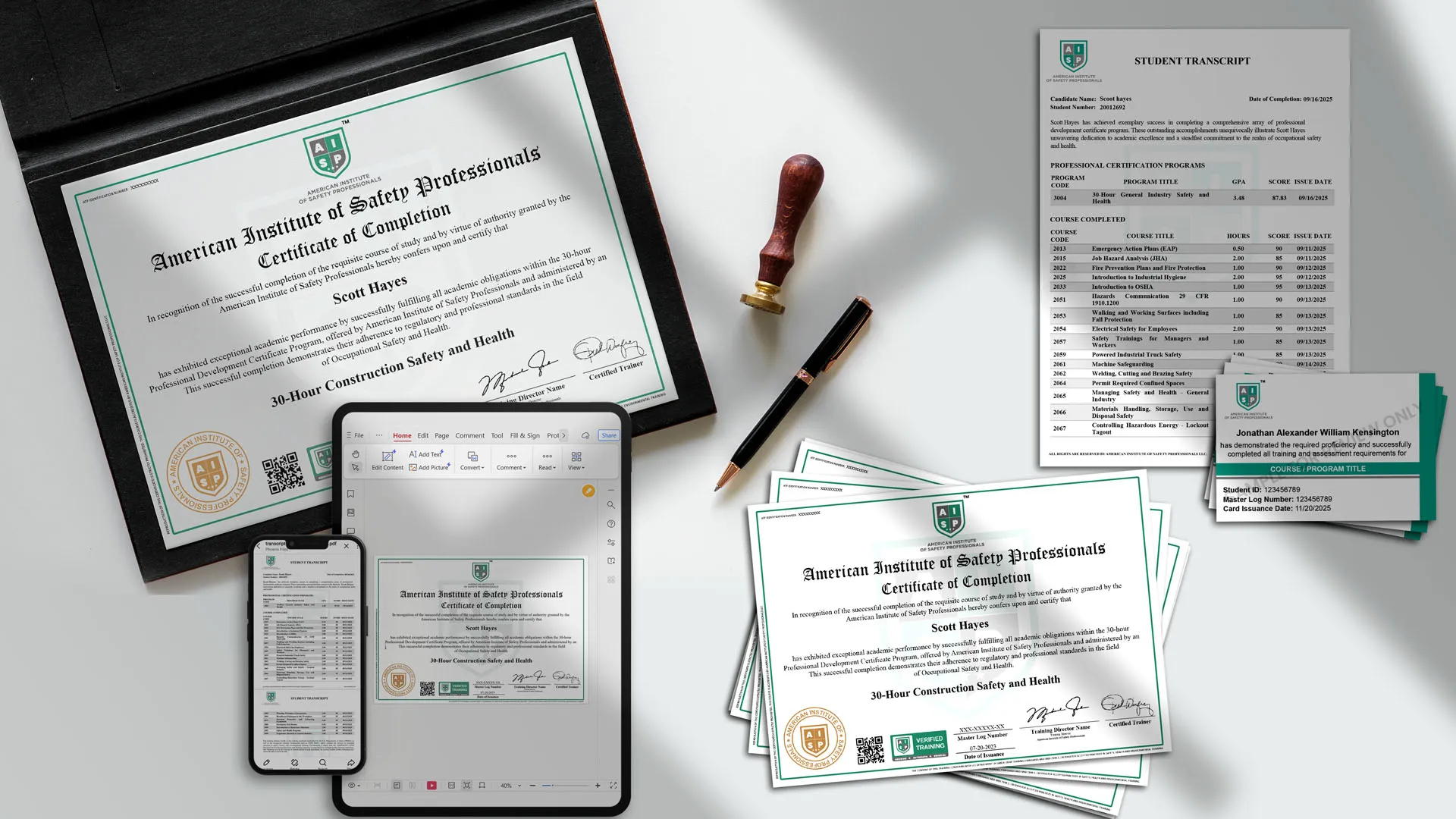
All training is delivered 100 percent online through leading delivery platforms and the American Institute of Safety Professionals Learning Management System (LMS). On successful completion, you receive an American Institute of Safety Professionals certificate, a professional wallet card, and an official transcript, all employer-verifiable at amiosp.com/student-verifications.
Learning Outcomes
Upon completing the Registered Health and Safety Manager (RHSM) program, participants will be able to:
- Design and implement safety management systems aligned with ISO 45001, ANSI Z10, and OSHA Recommended Practices, applying the Plan-Do-Check-Act cycle to establish, operate, and continuously improve the safety programme across the organisation.
- Build and lead the safety team: defining safety roles and responsibilities, hiring and developing safety professionals, establishing competency frameworks, conducting performance reviews, developing succession plans, and building team capability across diverse operational environments.
- Develop and manage the safety budget: operational expenditure (training, PPE, monitoring, inspection), capital expenditure (engineering controls, equipment, ventilation), ROI analysis for safety investments, EMR management, and presenting financial justification to executive leadership and finance.
- Architect contractor safety governance: pre-qualification systems, contract safety requirements, onsite monitoring frameworks, contractor performance scorecards, and multi-employer worksite compliance management.
- Direct safety performance measurement: designing dashboards with leading indicators (training completion, inspection scores, near-miss rates, observation counts) and lagging indicators (TRIR, DART, LTIFR, severity rate), benchmarking, trend analysis, and management review facilitation.
- Lead safety culture transformation: culture maturity assessment (Bradley Curve, Hudson Model), leadership engagement programming, just culture governance, reporting culture development, recognition systems, and multi-year culture improvement planning.
- Govern the incident investigation programme: investigation team composition, root-cause analysis quality assurance, corrective action lifecycle management, lessons-learned dissemination, and post-investigation programme improvement.
- Direct the enterprise audit programme: audit strategy, auditor competency management, audit execution against regulatory and management system standards, findings analysis, corrective action governance, and management review.
- Present safety strategy, performance, and investment recommendations to executive leadership and boards in the language of business value: cost avoidance, productivity impact, insurance optimisation, regulatory risk, ESG, and reputational value.
- Manage OSHA regulatory compliance at the programme level: maintaining the compliance framework, coordinating inspection response, managing citation abatement, and advising executive leadership on regulatory strategy.
Core Modules
- Safety Management System Design and Implementation: ISO 45001, ANSI Z10, OSHA Recommended Practices, PDCA cycle, gap analysis, implementation planning, documentation, certification readiness
- Safety Programme Architecture: policy, objectives, procedures, programme governance, training programme management, PPE programme governance, permit-to-work system design
- Safety Team Leadership and Development: organisation design, hiring, competency frameworks, performance management, coaching, succession planning, managing geographically dispersed teams
- Safety Budget and Resource Management: building budgets, capital vs operational expenditure, ROI analysis, EMR management, workers’ compensation, insurance programme management, executive financial justification
- Contractor Safety Governance: pre-qualification, contract safety specifications, onsite monitoring, performance scorecards, multi-employer compliance
- Safety Performance Measurement and Management Review: leading/lagging indicators, dashboards, benchmarking, trend analysis, management review per ISO 45001 Clause 9.3
- Safety Culture Assessment and Transformation: maturity models, leadership engagement, just culture, reporting culture, recognition, measurement, multi-year planning
- Incident Investigation Programme Governance: team composition, RCA quality assurance, corrective action lifecycle, lessons-learned, programme improvement
- Enterprise Audit Programme Management: audit strategy, auditor management, findings analysis, corrective action governance, regulatory readiness
- Executive Communication and Stakeholder Management: translating safety into business language, board reporting, cross-functional partnerships, crisis communication, ESG integration
Who Should Enroll
- Safety managers and HSE managers seeking the “Registered” management designation to advance beyond the Certified (CHSM) level
- Senior safety officers and RHSO holders preparing for promotion to safety management positions
- EHS directors and corporate safety leaders seeking formal management certification alongside their operational experience
- Operations managers and plant managers assuming safety programme ownership as part of expanded responsibilities
- Safety consultants seeking the senior management credential that validates programme design and governance competency to clients
- Professionals targeting HSE Director and VP Safety positions where management system governance, team leadership, and executive communication are required
- International safety professionals seeking the most advanced OSHA-aligned management certification recognised across 42 countries
Prerequisite: 3+ years of practical safety management experience is recommended. The CHSM, RHSO, or equivalent provides an excellent foundation. No formal academic degree is required.
Entry Requirements
- 3 or more years of practical safety management experience is recommended
- The CHSM, RHSO, CSS, or equivalent provides an excellent foundation
- No formal academic degree is required
- All instruction in English; professional proficiency required
Upon completion, graduates receive an American Institute of Safety Professionals certificate, wallet card, and transcript. Employer-verifiable at amiosp.com/student-verifications.
Certification Pathway
Certified Tier
- CSSP: Certified Safety Supervisor
- CSHT: Certified Safety and Health Trainer
- CSS: Certified Safety Specialist
- CHSO: Certified Health and Safety Officer
- CHSM: Certified Health and Safety Manager
Registered Tier
- RHSO: Registered Health and Safety Officer
- RHSM: Registered Health and Safety Manager — YOU ARE HERE
- RHSP: Registered Health and Safety Professional
- RSP: Registered Safety Professional
The RHSM is the Registered advancement from CHSM. RHSM holders seeking the broadest possible academic qualification should consider the International Diploma in Occupational Health and Safety Management (DIP-1003, 480 hours, 60 credits). Those seeking industry-specific diploma depth should consider DIP-1002 (Industrial), DIP-1008 (Construction), or DIP-1010 (Oil and Gas).
Course Content
The Registered Health and Safety Manager (RHSM) program is designed for experienced safety professionals, HSE managers, and organizational leaders who aim to enhance their expertise in managing comprehensive occupational safety and health programs. This course emphasizes hazard identification, risk management, regulatory compliance, and the implementation of effective safety management systems to ensure a safe and healthy working environment across industries.
Core Modules
Participants will explore essential topics to effectively manage and lead workplace safety initiatives:
- Advanced Occupational Safety and Health Standards and Regulations
- Hazard Identification and Risk Assessment Strategies
- Implementation and Management of Safety Programs
- Emergency Planning, Fire Safety, and Crisis Management
- Industrial Equipment Safety and Personal Protective Equipment (PPE) Management
- Behavioral Safety, Safety Culture, and Workforce Engagement
- Accident Investigation, Incident Reporting, and Root Cause Analysis
- Continuous Improvement, Auditing, and Compliance Monitoring
Optional / Specialized Modules
Participants may explore additional specialized topics to strengthen leadership and safety management skills:
- Industrial Hygiene and Workplace Health Programs
- Hazardous Materials Handling and Safety Communication (HazCom)
- Leadership in Safety Programs and Risk Management
- Case Studies in Safety Management and Organizational Success
The Registered Safety Manager (RSM) program equips participants with advanced knowledge, practical strategies, and professional leadership skills required to manage safety programs, ensure regulatory compliance, mitigate workplace hazards, and foster a proactive safety culture across industrial, construction, and corporate environments.
Mode of Delivery
Participants receive online training delivered through leading delivery platforms and the institute's Learning Management System (LMS). Training is provided directly by American Institute of Safety Professionals as well as through its network of Accredited Training Providers (ATPs), all backed by expert instruction and official study materials. Assessments are conducted online, and successful participants are awarded internationally recognized certificates.
To suit individual needs and schedules, participants can access training through the student dashboard and choose from a range of flexible delivery options, including blended learning, e-learning, remote and distance learning, and face-to-face instruction.
Program Duration
The program is designed to offer flexible online learning with a minimum instructional contact time of 40 hours. Most learners successfully complete the course within one month, allowing them to progress at their own pace while balancing professional commitments.
Examination
Candidates can take this exam through an assigned portal from the American Institute of Safety Professionals. A passing score is 70% or higher, and exam results are provided right after by email to the address provided.
The exam is open-book, allowing candidates to validate their answers. Any candidates who do not pass have 1 month after their exam to go through the training materials and can take the exam 3 additional times.
Additional Information
For questions about American Institute of Safety Professionals online fees, replacement certificates, additional hardbound materials or any other financial-related issues please feel free to contact accounts@amiosp.com
What You Will Get
Why Choose American Institute of Safety Professionals's Qualifications
- The Highest Management Certification in the American Institute of Safety Professionals Framework — the RHSM carries the “Registered” designation at the management level — the most advanced management credential available, above both CHSM (Certified) and RHSO (Registered Officer).
- Complete Programme Governance Competency — covers every dimension of safety management: system design (ISO 45001/ANSI Z10), team leadership, budget governance, contractor management, performance measurement, culture transformation, audit governance, and executive communication.
- Safety Budget and ROI Mastery — dedicated content on building safety budgets, ROI calculation, EMR management, insurance optimisation, and presenting financial justification to executive leadership — the business skills that separate managers from officers.
- Safety Culture Transformation — covers maturity assessment (Bradley Curve, Hudson Model), leadership engagement, just culture governance, and multi-year culture planning — the long-term performance driver that RHSM holders are expected to lead.
- Executive Communication — develops the skill of translating safety metrics into business language: cost avoidance, productivity impact, ESG reporting, regulatory risk, and competitive advantage — the communication competency that C-suite leaders require from their safety managers.
- Career Acceleration Credential — positions holders for EHS Director, VP Safety, and corporate governance roles across all industries. The “Registered” designation signals readiness for the highest management responsibilities.
- 100% Online, Flexible, Recognised Across 42 Countries — employer-verifiable at amiosp.com/student-verifications.
Dedicated Support & Response
Each client is assigned a dedicated account manager to provide personalized guidance and expert support. Our team is committed to responding to all queries within 24 hours, ensuring a seamless and responsive learning experience.
Career Opportunities
- Safety Manager / HSE Manager — directing the safety programme for a facility, business unit, or project. Typical salary range: $85,000 to $130,000 (USA); $6,000 to $15,000/month (Gulf region, tax-free).
- EHS Director / Corporate Safety Director — leading the safety function across multiple facilities or an entire organisation. Typical salary range: $120,000 to $185,000 (USA); $10,000 to $22,000/month (Gulf region).
- Regional Safety Manager — governing safety across all operations within a geographic region. Typical salary range: $100,000 to $155,000 (USA).
- Safety Programme Manager — designing and implementing safety programmes for organisations establishing or restructuring their safety function. Typical salary range: $90,000 to $140,000 (USA).
- Senior Safety Management Consultant — providing programme design, management system implementation, audit governance, and executive advisory services. Senior consultants command daily rates of $1,000 to $2,500.
The RHSM is the credential that transitions safety professionals from doing safety work to leading the safety function, and from the Certified level to the Registered professional standard that employers and clients recognise as the highest management designation.
Frequently Asked Questions (FAQs)
Q: What is the difference between the RHSM and the CHSM?
A: Both are management-level
credentials, but the CHSM (Certified Health and Safety Manager) is the
Certified tier and the RHSM (Registered Health and Safety Manager) is the
Registered tier, the highest management designation in the American Institute
of Safety Professionals framework. The CHSM is the entry into safety
management, while the RHSM is the senior management credential covering
management-system architecture, team leadership, safety budgeting and ROI,
contractor governance, performance measurement, culture transformation,
audit-programme governance, and executive communication.
Q: How is the RHSM assessed?
A: Assessment is a single
online open-book examination taken through an assigned American Institute of
Safety Professionals portal. The pass mark is 70 percent, and results are sent
to you by email immediately after submission. Because the exam is open-book,
you can confirm your answers against the course materials as you work.
Candidates who do not pass have one month to review the training materials and
may re-sit the exam up to three further times.
Q: How long does the RHSM take to complete?
A: The course carries a
minimum instructional contact time of 60 hours. It is delivered 100 percent
online and is fully self-paced, and most learners complete it within one month
while balancing their professional commitments.
Q: Who is the RHSM for, and do I need prior qualifications?
A: The RHSM is designed for
experienced safety and HSE managers, EHS directors, and senior professionals
targeting HSE Director or VP Safety roles. Three or more years of practical
safety management experience is recommended, and the CHSM, RHSO, or an
equivalent qualification provides an excellent foundation. No formal academic
degree is required, and all instruction is delivered in English.
Q: Does the RHSM cover ISO 45001 and management systems?
A: Yes. The RHSM provides
comprehensive coverage of designing and implementing safety management systems
aligned with ISO 45001, ANSI Z10, and OSHA Recommended Practices, including gap
analysis, the Plan-Do-Check-Act cycle, documentation systems, performance evaluation,
and management review.
Q: Does the RHSM cover safety budgeting and ROI?
A: Yes. The RHSM includes
dedicated coverage of building safety budgets, distinguishing capital and
operational expenditure, calculating return on investment for safety
initiatives, managing the Experience Modification Rate and insurance
programmes, and presenting financial justification to executive leadership.
Q: What will I receive upon completion of the RHSM?
A: On successful
completion you receive an American Institute of Safety Professionals
certificate, a professional wallet card, and an official transcript. All
credentials are employer-verifiable at amiosp.com/student-verifications.
- 265 Hackensack St Wood Ridge, New Jersey 07075 USA
- +1 689 286 3561
- info@amiosp.com
Apply Coupon
Enter your code to unlock savings on this order
Original Price
$349.99
Listed Saving
− $0.00
Coupon Discount
− $0.00
Tax (0%)
$0.00
Final Price
$249.99
Our Featured
Trainings
Save 33%
Certified Health and Safety Officer (CHSO)
The Certified Health and Safety Officer (CHSO) course delivers training in safety management, hazard identification, and OSHA compliance. Offered by the American Institute of Safety Professionals, it equips officers to implement protocols, manage risks, and sustain a compliant workplace across key industries.
$199.99
$299.99
Buy Now
Save 33%
Certified Safety Engineer (CSE)
The Certified Safety Engineer (CSE) course delivers training in safety engineering, risk assessment, and accident prevention. Offered by the American Institute of Safety Professionals, it equips engineers to design safety systems, ensure OSHA compliance, and control workplace hazards across global industries.
$199.99
$299.99
Buy Now
Save 33%
Certified Fire Prevention Professional (CFPP)
The Certified Fire Prevention Professional (CFPP) course delivers expert training in fire risk assessment, prevention, and compliance. Offered by the American Institute of Safety Professionals, it equips professionals to develop fire prevention plans and uphold OSHA and NFPA fire safety standards in industry.
$199.99
$299.99
Buy Now
Save 33%
Certified Health and Safety Manager (CHSM)
The Certified Health and Safety Manager (CHSM) course delivers expert training in safety management, hazard identification, and OSHA compliance. Offered by the American Institute of Safety Professionals, it equips managers to develop safety programs and ensure compliant, safe workplaces across key industries.
$199.99
$299.99
Buy Now
Save 33%
Certified Healthcare Safety Professional (CHSP)
The Certified Healthcare Safety Professional (CHSP) course equips professionals to manage workplace safety in healthcare settings. Offered by the American Institute of Safety Professionals, it focuses on risk control, OSHA and CDC compliance, and protecting patients, staff and visitors across care facilities.
$199.99
$299.99
Buy Now
Save 58%
Certified Generative AI Health and Safety Professional (CGAHS)
The Certified Generative AI Health and Safety Professional (CGAHS) course equips professionals with AI-powered skills for risk assessments, hazard control, and OSHA compliance. Offered by the American Institute of Safety Professionals, it applies generative AI tools to enhance reporting, training, and safety.
$249.99
$599.99
Buy Now


/Images/POP Up.jpg)