


/Course Certificates/Registered Safety Officer (RSO) Certificate - American Institute of Safety Professionals.webp)
/Course Wallet Front/Courses Student Wallet Card Front - American Institute of Safety Professionals USA.webp)
/Course Wallet Back/Courses Student Wallet Card Back - American Institute of Safety Professionals USA.webp)

265 Hackensack St
Wood Ridge, New Jersey 07075 USA
SAFETY IS NOT A CHOICE, IT'S A RESPONSIBILITY WE OWE TO OURSELVES AND THOSE AROUND US
Registered Health and Safety Officer (RHSO)
- January 01, 2026 - December 31, 2027
- Self Paced Flexible Timings
- Free Enrollments
- Student Dashboard or Blended Learning
- +1 689 286 3561
- info@amiosp.com
Course Overview
The Registered Health and Safety Officer (RHSO) is a registered-tier professional certification from the American Institute of Safety Professionals that validates the competency of safety officers and site-level HSE professionals who manage day-to-day safety operations, maintain regulatory compliance, lead workplace inspections, conduct incident investigations, coordinate safety committees, and serve as the organisation’s on-site safety authority. The “Registered” designation signifies a higher level of professional recognition than the “Certified” tier (CHSO), demonstrating that the holder has met the American Institute of Safety Professionals’s advanced requirements for independent professional practice as a health and safety officer.
The safety officer is the backbone of every organisation’s safety programme. Managers design the programme and set strategy. Supervisors enforce compliance on the shop floor. Trainers build competency. But it is the safety officer who operates the programme on a daily basis: conducting the inspections that identify hazards before they cause injuries, maintaining the OSHA recordkeeping (29 CFR 1904) that demonstrates compliance during regulatory inspections, leading the incident investigations that prevent recurrence, managing the PPE programme that protects workers, coordinating the safety committee that provides worker participation, running the emergency drills that verify preparedness, and maintaining the compliance documentation that proves the organisation is meeting its regulatory obligations.
The RHSO curriculum covers the complete operational safety officer competency: OSHA 29 CFR 1910 (General Industry) and 29 CFR 1926 (Construction) compliance management, systematic hazard identification and risk assessment, safety policy and procedure development, workplace inspection planning and execution, incident investigation with root cause analysis, emergency action plan implementation, PPE programme management, safety committee coordination, behavioural safety and culture leadership, compliance documentation and OSHA recordkeeping, and the professional communication skills needed to report safety performance to management and interface with OSHA compliance officers during inspections.
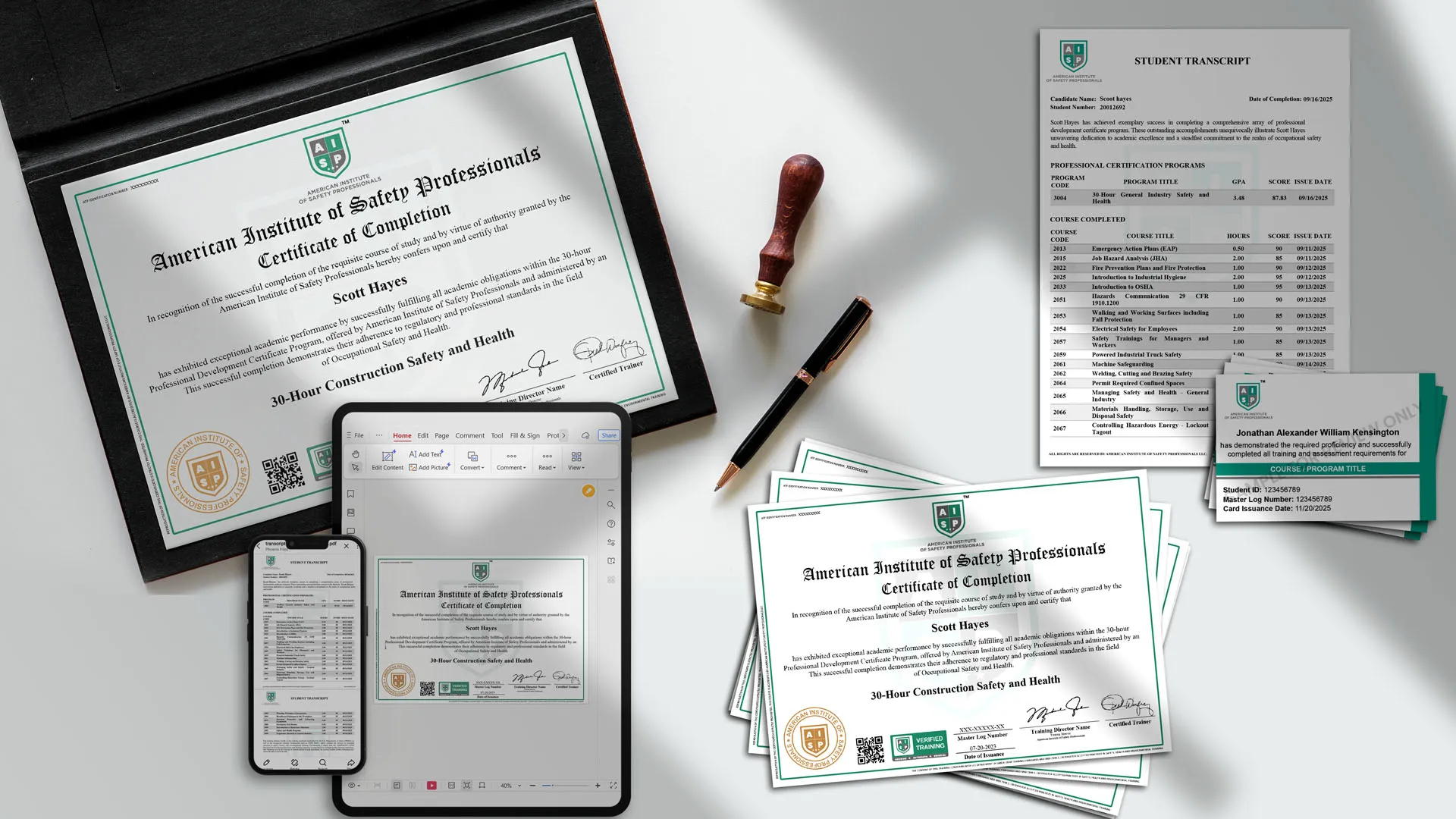
All training is delivered 100 percent online through leading delivery platforms and the American Institute of Safety Professionals Learning Management System (LMS). On successful completion, you receive an American Institute of Safety Professionals certificate, a professional wallet card, and an official transcript, all employer-verifiable at amiosp.com/student-verifications.
Learning Outcomes
Upon completing the Registered Health and Safety Officer (RHSO) program, participants will be able to:
- Manage OSHA 29 CFR 1910 and 29 CFR 1926 compliance for a facility or project site: understanding employer obligations, employee rights, recordkeeping requirements (29 CFR 1904), and the regulatory basis for each safety requirement the officer is responsible for maintaining.
- Plan and conduct systematic workplace inspections covering all operational areas, using structured checklists aligned with applicable OSHA standards, documenting findings with photographs and descriptions, prioritising corrective actions by risk severity, and tracking completion to closure.
- Conduct incident investigations from scene preservation through witness interviews, evidence collection, root-cause analysis (5 Whys, Ishikawa), corrective action recommendations, and management reporting, ensuring investigations produce actionable improvements rather than blame.
- Develop, implement, and maintain written safety policies, standard operating procedures, and safe work instructions that ensure compliance and communicate expectations clearly to workers and supervisors.
- Manage the facility PPE programme: conducting PPE hazard assessments per 29 CFR 1910.132(d), selecting appropriate PPE, managing inventory and distribution, verifying fit and condition, and maintaining the documentation that demonstrates compliance.
- Coordinate and lead the safety committee: scheduling meetings, setting agendas, facilitating discussions, documenting minutes and action items, tracking corrective action completion, and reporting committee recommendations to management.
- Implement and manage emergency action plans per OSHA 29 CFR 1910.38: evacuation procedures, alarm systems, emergency communication, drill scheduling and evaluation, and coordination with local emergency services.
- Maintain OSHA recordkeeping and compliance documentation: OSHA 300 Log, 300A annual summary, 301 incident reports, training records, inspection logs, and the document management systems that demonstrate compliance during regulatory inspections and audits.
- Apply behavioural safety observation techniques, coach workers on safe practices, lead safety culture initiatives at the site level, and model the visible safety leadership that builds trust and reporting culture among the workforce.
- Interface with OSHA compliance officers during inspections: understanding the inspection process (opening conference, walkaround, closing conference), the officer’s role during walkaround, employee interview protocols, and post-inspection documentation and abatement management.
Core Modules
- OSHA Regulatory Compliance Management: 29 CFR 1910 and 1926 from the safety officer’s operational perspective, employer obligations, employee rights, and the compliance framework the officer maintains daily
- Hazard Identification and Risk Assessment: systematic hazard recognition, JHA, risk matrices, hierarchy of controls, and the hazard assessment process that informs every inspection and corrective action
- Safety Policy and Procedure Development: writing policies, SOPs, and safe work instructions that communicate requirements clearly and meet OSHA documentation expectations
- Workplace Inspection Planning and Execution: inspection scheduling, area-specific checklists, finding documentation, corrective action prioritisation, tracking, and follow-up verification
- Incident Investigation and Root Cause Analysis: scene preservation, witness interviewing, 5 Whys, Ishikawa diagrams, investigation report writing, corrective action lifecycle, and management reporting
- Emergency Planning and Drill Management: emergency action plans, fire prevention plans, evacuation procedures, alarm systems, drill design, evaluation, and emergency services coordination
- PPE Programme Management: hazard assessment, PPE selection, fit verification, inspection, maintenance, inventory management, and compliance documentation
- Safety Committee Coordination: meeting facilitation, agenda management, minutes documentation, action item tracking, and reporting committee outputs to management
- Behavioural Safety and Culture Leadership: safety observation techniques, coaching, positive reinforcement, visible leadership, and site-level culture building
- OSHA Recordkeeping and Compliance Documentation: 300 Log, 300A, 301 forms, training records, inspection records, and the document management that demonstrates compliance
Who Should Enroll
- Safety officers and HSE officers seeking the “Registered” designation to advance beyond the “Certified” (CHSO) level
- Site safety coordinators and facility safety coordinators managing daily safety operations and compliance documentation
- Safety professionals in manufacturing, construction, oil and gas, warehousing, healthcare, and general industry who serve as the on-site safety authority
- CHSO holders seeking advancement to the Registered tier to demonstrate independent professional practice competency
- Supervisors and operations managers who have been assigned safety officer responsibilities and need structured training in the complete officer function
- Safety professionals preparing for or complementing the Certified Health and Safety Manager (CHSM) credential
- International safety officers from the Gulf region, Asia, and Africa seeking an OSHA-aligned registered officer credential recognised across 42 countries
Prerequisite: 2+ years of practical safety experience is recommended. The CHSO or equivalent officer certification provides an excellent foundation. No formal academic degree is required.
Entry Requirements
- 2 or more years of practical safety experience is recommended
- The CHSO or equivalent officer certification provides an excellent foundation
- No formal academic degree is required
- All instruction in English; professional proficiency required
Upon completion, graduates receive an American Institute of Safety Professionals certificate, wallet card, and transcript. Employer-verifiable at amiosp.com/student-verifications.
Certification Pathway
Certified Tier
- CSSP: Certified Safety Supervisor
- CSHT: Certified Safety and Health Trainer
- CSS: Certified Safety Specialist
- CHSO: Certified Health and Safety Officer
Registered Tier
- RHSO: Registered Health and Safety Officer — YOU ARE HERE
- RHSP: Registered Health and Safety Professional
- RSM: Registered Safety Manager
- RSP: Registered Safety Professional
The RHSO is the “Registered” advancement from the CHSO (Certified Health and Safety Officer). RHSO holders seeking management-level advancement should consider the CHSM (Certified Health and Safety Manager) or RSM (Registered Safety Manager) as their next step.
Course Content
The Registered Health and Safety Officer (RHSO) program is designed for safety practitioners, site supervisors, and HSE coordinators who aim to strengthen their knowledge and skills in workplace safety management. This course emphasizes hazard identification, risk assessment, regulatory compliance, and practical strategies to ensure a safe and healthy working environment across industrial and construction sites.
Core Modules
Participants will explore essential topics to effectively manage workplace safety and implement safety programs:
- Introduction to Occupational Safety and Health Standards and Regulations
- Hazard Identification and Risk Assessment Techniques
- Implementation of Safety Programs and Compliance Monitoring
- Emergency Planning, Fire Safety, and First Aid Procedures
- Personal Protective Equipment (PPE) Selection and Management
- Behavioral Safety, Safety Culture, and Workforce Engagement
- Accident Investigation, Incident Reporting, and Root Cause Analysis
- Continuous Safety Improvement Strategies
Optional / Specialized Modules
Participants may explore additional specialized topics to enhance their skills and professional expertise:
- Industrial Hygiene and Occupational Health Programs
- Hazardous Materials Handling and Safety Communication (HazCom)
- Leadership in Safety Programs and Risk Management
- Case Studies in Workplace Safety Success
The Registered Safety Officer (RSO) program equips participants with practical knowledge, professional strategies, and skills required to effectively manage safety programs, ensure regulatory compliance, mitigate workplace hazards, and foster a proactive safety culture within industrial, construction, and corporate environments.
Mode of Delivery
Participants receive online training delivered through leading delivery platforms and the institute's Learning Management System (LMS). Training is provided directly by American Institute of Safety Professionals as well as through its network of Accredited Training Providers (ATPs), all backed by expert instruction and official study materials. Assessments are conducted online, and successful participants are awarded internationally recognized certificates.
To suit individual needs and schedules, participants can access training through the student dashboard and choose from a range of flexible delivery options, including blended learning, e-learning, remote and distance learning, and face-to-face instruction.
Program Duration
The program is designed to offer flexible online learning with a minimum instructional contact time of 40 hours. Most learners successfully complete the course within one month, allowing them to progress at their own pace while balancing professional commitments.
Examination
Candidates can take this exam through an assigned portal from the American Institute of Safety Professionals. A passing score is 70% or higher, and exam results are provided right after by email to the address provided.
The exam is open-book, allowing candidates to validate their answers. Any candidates who do not pass have 1 month after their exam to go through the training materials and can take the exam 3 additional times.
Additional Information
For questions about American Institute of Safety Professionals online fees, replacement certificates, additional hardbound materials or any other financial-related issues please feel free to contact accounts@amiosp.com
What You Will Get
Why Choose American Institute of Safety Professionals's Qualifications
- Registered Tier — Above Certified — the RHSO carries the “Registered” designation, which represents a higher level of professional recognition than “Certified” (CHSO) within the American Institute of Safety Professionals framework. “Registered” signifies independent professional practice competency validated by the institute.
- Complete Safety Officer Operational Competency — covers every function the safety officer performs daily: inspections, investigations, compliance documentation, PPE management, committee coordination, emergency drills, OSHA recordkeeping, and OSHA inspection interface.
- OSHA Recordkeeping and Documentation Mastery — dedicated content on the 300 Log, 300A, 301 forms, training records, and the document management systems that safety officers maintain — the compliance documentation that OSHA inspectors review first.
- Safety Committee Leadership — dedicated content on facilitating committees, setting agendas, documenting minutes, tracking actions, and reporting outcomes — the committee coordination function that most safety training ignores entirely.
- Dual Regulatory Coverage — covers both OSHA 29 CFR 1910 (General Industry) and 29 CFR 1926 (Construction), making the RHSO valuable across both sectors.
- Career Pathway Credential — the RHSO positions holders for advancement to CHSM (Certified Health and Safety Manager) and RSM (Registered Safety Manager) within the American Institute of Safety Professionals professional certification framework.
- 100% Online, Flexible, Recognised Across 42 Countries — employer-verifiable at amiosp.com/student-verifications.
Dedicated Support & Response
Each client is assigned a dedicated account manager to provide personalized guidance and expert support. Our team is committed to responding to all queries within 24 hours, ensuring a seamless and responsive learning experience.
Career Opportunities
- Registered Safety Officer / Senior Safety Officer — the on-site safety authority responsible for inspections, investigations, compliance documentation, and safety programme operations. Typical salary range: $55,000 to $85,000 (USA); $3,000 to $8,000/month (Gulf region).
- Site HSE Officer — managing health, safety, and environmental compliance at a construction site, manufacturing facility, or industrial operation. Typical salary range: $52,000 to $80,000 (USA); $3,500 to $9,000/month (Gulf region).
- Safety Compliance Officer / Regulatory Compliance Coordinator — managing OSHA compliance documentation, recordkeeping, and audit readiness for a facility or business unit. Typical salary range: $55,000 to $82,000 (USA).
- Safety Committee Coordinator — leading the safety committee function: meetings, agendas, action tracking, and management reporting. Often combined with safety officer responsibilities.
- Safety Consultant (Officer Level) — providing safety inspection, compliance documentation, and programme operations consulting services. Officer-level consultants command daily rates of $500 to $1,000.
The RHSO is the “Registered” officer credential that signals to employers, clients, and regulatory authorities that the holder operates at a professional standard above basic certification.
Frequently Asked Questions (FAQs)
Q: What is the difference between the RHSO and the CHSO?
A: Both are officer-level
credentials, but the CHSO (Certified Health and Safety Officer) is the
Certified tier and the RHSO (Registered Health and Safety Officer) is the
Registered tier, which represents a higher level of professional recognition
within the American Institute of Safety Professionals framework. The CHSO is
the entry into the officer role, while the RHSO validates the complete
operational competency of an officer who runs the safety programme day to day:
inspections, OSHA recordkeeping, PPE programme management, safety committee
coordination, incident investigation, emergency drills, and the OSHA inspection
interface.
Q: How is the RHSO assessed?
A: Assessment is a single
online open-book examination taken through an assigned American Institute of
Safety Professionals portal. The pass mark is 70 percent, and results are sent
to you by email immediately after submission. Because the exam is open-book,
you can confirm your answers against the course materials as you work.
Candidates who do not pass have one month to review the training materials and
may re-sit the exam up to three further times.
Q: How long does the RHSO take to complete?
A: The course carries a
minimum instructional contact time of 8 hours. It is delivered 100 percent
online and is fully self-paced, and most learners complete it within one month
while balancing their professional commitments.
Q: Who is the RHSO for, and do I need prior qualifications?
A: The RHSO is designed for
practising safety officers and site-level HSE professionals seeking the
Registered designation above the Certified (CHSO) level. Two or more years of
practical safety experience is recommended, and the CHSO or an equivalent
officer certification provides an excellent foundation. No formal academic
degree is required, and all instruction is delivered in English.
Q: Does the RHSO cover OSHA recordkeeping?
A: Yes. The RHSO includes
dedicated coverage of OSHA recordkeeping under 29 CFR 1904, including the OSHA
300 Log, the 300A annual summary, and 301 incident reports, along with the
training records, inspection logs, and document-management systems that OSHA
inspectors review first during a compliance inspection.
Q: Does the RHSO cover both general industry and construction?
A: Yes. The RHSO covers both
OSHA 29 CFR 1910 (general industry) and 29 CFR 1926 (construction) at the
safety officer's operational level, making the credential valuable across both
sectors.
Q: What will I receive upon completion of the RHSO?
A: On successful
completion you receive an American Institute of Safety Professionals
certificate, a professional wallet card, and an official transcript. All
credentials are employer-verifiable at amiosp.com/student-verifications.
- 265 Hackensack St Wood Ridge, New Jersey 07075 USA
- +1 689 286 3561
- info@amiosp.com
Apply Coupon
Enter your code to unlock savings on this order
Original Price
$349.99
Listed Saving
− $0.00
Coupon Discount
− $0.00
Tax (0%)
$0.00
Final Price
$249.99
Our Featured
Trainings
Save 33%
Certified Health and Safety Officer (CHSO)
The Certified Health and Safety Officer (CHSO) course delivers training in safety management, hazard identification, and OSHA compliance. Offered by the American Institute of Safety Professionals, it equips officers to implement protocols, manage risks, and sustain a compliant workplace across key industries.
$199.99
$299.99
Buy Now
Save 33%
Certified Safety Engineer (CSE)
The Certified Safety Engineer (CSE) course delivers training in safety engineering, risk assessment, and accident prevention. Offered by the American Institute of Safety Professionals, it equips engineers to design safety systems, ensure OSHA compliance, and control workplace hazards across global industries.
$199.99
$299.99
Buy Now
Save 33%
Certified Fire Prevention Professional (CFPP)
The Certified Fire Prevention Professional (CFPP) course delivers expert training in fire risk assessment, prevention, and compliance. Offered by the American Institute of Safety Professionals, it equips professionals to develop fire prevention plans and uphold OSHA and NFPA fire safety standards in industry.
$199.99
$299.99
Buy Now
Save 33%
Certified Health and Safety Manager (CHSM)
The Certified Health and Safety Manager (CHSM) course delivers expert training in safety management, hazard identification, and OSHA compliance. Offered by the American Institute of Safety Professionals, it equips managers to develop safety programs and ensure compliant, safe workplaces across key industries.
$199.99
$299.99
Buy Now
Save 33%
Certified Healthcare Safety Professional (CHSP)
The Certified Healthcare Safety Professional (CHSP) course equips professionals to manage workplace safety in healthcare settings. Offered by the American Institute of Safety Professionals, it focuses on risk control, OSHA and CDC compliance, and protecting patients, staff and visitors across care facilities.
$199.99
$299.99
Buy Now
Save 58%
Certified Generative AI Health and Safety Professional (CGAHS)
The Certified Generative AI Health and Safety Professional (CGAHS) course equips professionals with AI-powered skills for risk assessments, hazard control, and OSHA compliance. Offered by the American Institute of Safety Professionals, it applies generative AI tools to enhance reporting, training, and safety.
$249.99
$599.99
Buy Now


/Images/POP Up.jpg)